Posted in Hospital Appointments, My Tests Explained

My Hospital Appointment – ERG test – Electroretinography Part 2

Photograph of a womans eye with white dot sensors around the eye. Electroretinography
So, this is sort of what an ERG ( Electroretinography) test is.
Did you wince? ☺
First of all you have some anesthetic drops popped in your eyes.
A cotton/hair thickness wire is then put to your eye and pads put on your face. Forehead and at each temple.
Around 5 wires run from your head to be plugged into a machine.
Then you have to look at the flashing chequered grid for sometime.
After this, dilating drops are put in your eyes.
Then you sit in the dark without doing anything to let your eyes become accustomed to the darkness.
The next machine is like the visual field test I had.
You place your chin and face into the machine, then for about 20 minutes, white light pulsing and flashes at intervals.
You have to stare at a small red light and not blink while it flashes. You get a countdown to the next set of lights so you can time your blinking.
After that, it’s done, so you are unplugged.
Felt like an eyelash was annoying me in both eyes but it wasn’t as bad as I first thought.
It was more uncomfortable with the bright light. Which I’m photophobic anyway now as light hurts my eyes, hence part of why I’m having these tests for.
This tests finds out the condition and health of the light sensors in your retina, By electrical responses.
They feel better now but still slightly painful 2 days later.
Posted in My Tests Explained

What is Retinal Photography?

What is Retina photography?

The main objective of using this technology is to improve the opticians or consultants ability to determine the status of your retina health in a better way. Early detection of eye disease is crucial and retinal photography helps them diagnose potential problems before they become too serious.

I have had this done at the opticians and the hospitals. (The first time I was given this in a routine eye test in an opticians, it lead to my diagnosis) other eye tests in the past never picked this up. Mainly, as this service wasn’t available then.

The docready for the examination.

Next you pop your head onto a chin and forehead support to keep your head still whilst placed in front of the machine.

You stare at an object while a laser scans your eyes. The photographs are then viewed on a computer. The images will be upto a 100 times magnified.

It’s painless and gives the professionals a good view of the back of your eye.

Posted in My Tests Explained

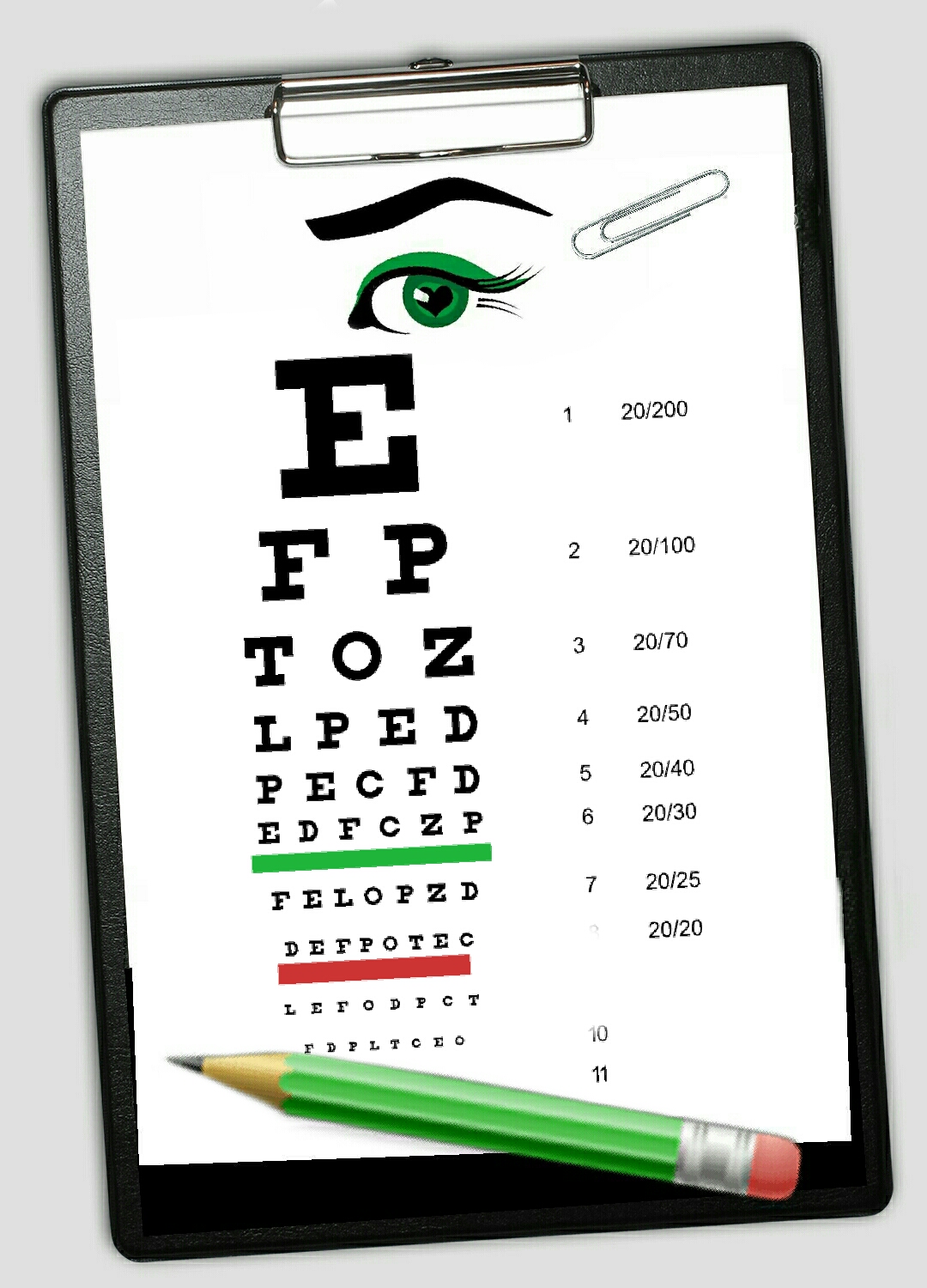
The Snellen chart

Picture of the Snellen chart on clipboard

When I have this test, I’m told to leave my distance glasses on. If I’m struggling, the nurse gives me pinhole glasses which help focus the eye through tiny holes.

The Snellen chart is printed with eleven lines of block letters. The first line consists of one very large letter, which may be one of several letters, for example E, H, or N.

Only ten letters are used C, D, E, F, L, N, O, P, T, Z.
Subsequent rows have increasing numbers of letters that decrease in size. A person taking the test covers one eye from 6 metres or 20 feet away, and reads aloud the letters of each row, beginning at the top. The smallest row that can be read accurately indicates the visual acuity in that specific eye.